Discover Head-to-Head Data for Retevmo versus First-Line Standards of Care and Find Original Phase I/II Trial Results
Retevmo: The first precision oncology treatment approved by the FDA for certain RET-driven solid tumors, regardless of type1,2

Selpercatinib (Retevmo) is a National Comprehensive Cancer Network® (NCCN®)-recommended treatment option for certain patients with RET-positive metastatic non-small cell lung cancer (NSCLC) and RET-positive advanced or metastatic thyroid carcinoma3,4*
See NCCN Clinical Practice Guidelines in Oncology (NCCN Guidelines®) recommendations
NCCN makes no warranties of any kind whatsoever regarding their content, use or application and disclaims any responsibility for their application or use in any way.
*The NCCN Guidelines provide recommendations for certain individual biomarkers that should be tested and recommend testing techniques but do not endorse any specific commercially available biomarker assays or commercial laboratories. See the NCCN Guidelines for detailed recommendations, including other preferred treatment options.
The clinical data for Retevmo were from LIBRETTO-001, a phase I/II, multicohort, open-label, single-arm clinical trial.1,5
Retevmo is the first precision medicine approved specifically for patients with RET-driven advanced or metastatic solid tumors, regardless of tumor type1
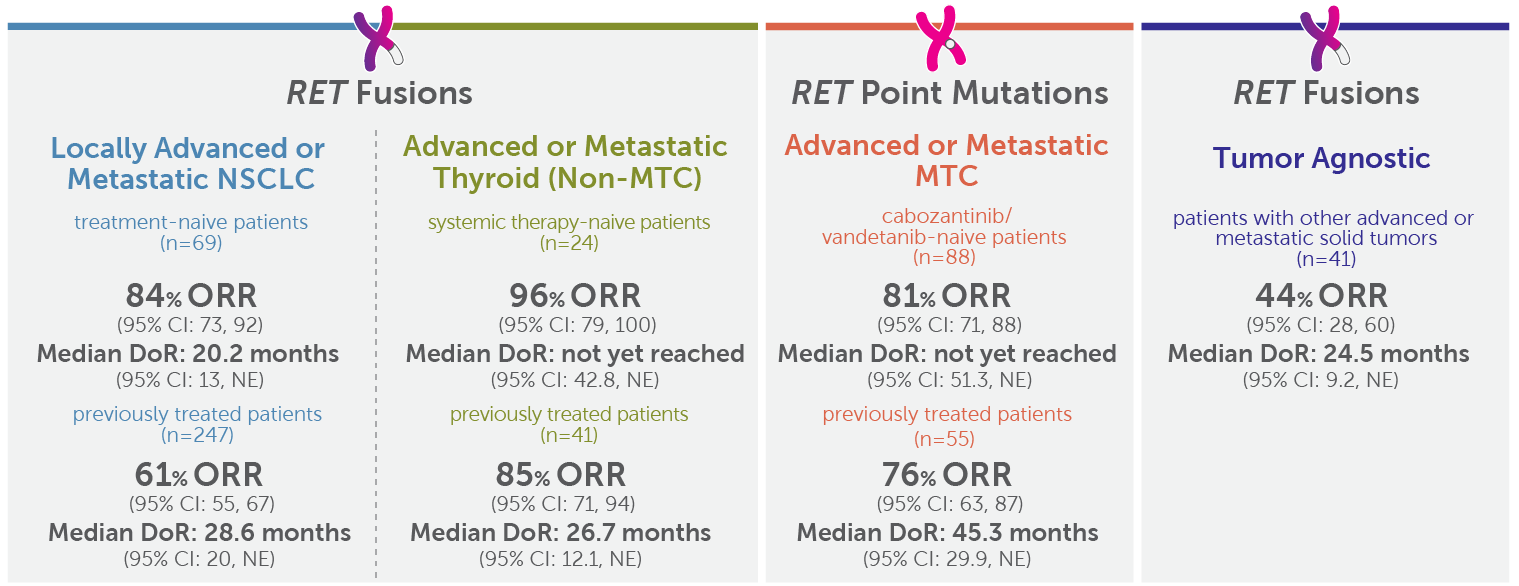
RET Fusions
Locally Advanced or Metastatic NSCLC
-
treatment-naive patients (n=69):
- 84% ORR (95% CI: 73, 92)
- Median DoR: 20.2 months (95% CI: 13, NE)
-
previously treated patients (n=247):
- 61% ORR (95% CI: 55, 67)
- Median DoR: 28.6 months (95% CI: 20, NE)
Advanced or Metastatic RET Fusion-Positive Thyroid (Non-MTC)
-
systemic therapy-naive patients (n=24):
- 96% ORR (95% CI: 79, 100)
- Median DoR: not yet reached (95% CI: 42.8, NE)
-
previously treated patients (n=41)
- 85% ORR (95% CI: 71, 94)
- Median DoR: 26.7 months (95% CI: 12.1, NE)
RET Point Mutations
Advanced or Metastatic MTC
-
cabozantinib/vandetanib-naive patients (n=88):
- 81% ORR (95% CI: 71, 88)
- Median DoR: not yet reached (95% CI: 51.3, NE)
-
previously treated patients (n=55):
- 76% ORR (95% CI: 63, 87)
- Median DoR: 45.3 months (95% CI: 29.9, NE)
RET Fusions
Tumor Agnostic
-
patients with other advanced or metastatic solid tumors (n=75)
- 47% ORR (95% CI: 35, 59)
- Median DoR: 24.5 months (95% CI: 11.2, 49.1)
- Evaluated in the largest phase I/II trial of patients with RET-driven cancers (N=857), including those with brain metastases1
- In patients with locally advanced or metastatic RET fusion-positive NSCLC and measurable brain metastases (n=21), responses in intracranial lesions were observed in 86% of evaluable patients (4 of 5 treatment-naive patients and 14 of 16 previously treated patients). 39% and 38% of responders in the previously treated and treatment-naive cohorts, respectively, had a DoR of ≥12 months1*†
- Permanent discontinuation due to an adverse reaction occurred in 10% of patients who received RETEVMO. Adverse reactions resulting in permanent discontinuation in ≥0.5% of patients included increased ALT (0.7%), fatigue (0.6%), sepsis (0.5%), pneumonia (0.5%), and increased AST (0.5%).1
*Patients were treatment naïve or previously treated with platinum-based chemotherapy and had measurable CNS lesions at baseline according to IRC assessment.1
†3 patients received RT to the brain within 2 months prior to study entry; 1 patient in the previously treated cohort and 2 patients in the treatment-naïve cohort.1
ALT=alanine aminotransferase; AR=adverse reaction; AST=aspartate aminotransferase; CNS=central nervous system; DoR=duration of response; IRC=independent review committee; NE=not estimable; RET=rearranged during transfection; RT=radiation therapy.
Reference: 1. Retevmo (selpercatinib). Prescribing Information. Lilly USA, LLC.
Take action on RET. First, test. Then treat.
Select Important Safety Information
The labeling for Retevmo contains Warnings and Precautions for hepatotoxicity, interstitial lung disease (ILD)/pneumonitis, hypertension, QT interval prolongation, hemorrhagic events, hypersensitivity, tumor lysis syndrome (TLS), risk of impaired wound healing, hypothyroidism, embryo-fetal toxicity, and slipped capital femoral epiphysis/slipped upper femoral epiphysis (SCFE/SUFE) in pediatric patients.
Monitor alanine aminotransferase (ALT) and aspartate aminotransferase (AST) prior to initiating Retevmo, every 2 weeks during the first 3 months of treatment, then monthly thereafter and as clinically indicated. Monitor for new or worsening pulmonary symptoms indicative of ILD/pneumonitis. Optimize blood pressure prior to initiating Retevmo. Monitor blood pressure after 1 week, at least monthly, and as clinically indicated. Monitor patients who are at significant risk of developing QTc prolongation, including patients with known long QT syndromes, clinically significant bradyarrhythmias, and severe or uncontrolled heart failure. Monitor the QT interval more frequently when Retevmo is concomitantly administered with strong and moderate CYP3A inhibitors or drugs known to prolong QTc interval. Permanently discontinue Retevmo in patients with severe or life-threatening hemorrhage. If hypersensitivity occurs, withhold Retevmo and begin corticosteroids at a dose of 1 mg/kg prednisone (or equivalent). See full Prescribing Information for further management instructions and dosage modifications for adverse reactions. Closely monitor patients that may be at risk of TLS (rapidly growing tumors, a high tumor burden, renal dysfunction, or dehydration) and consider appropriate prophylaxis including hydration. Withhold Retevmo for at least 7 days prior to elective surgery. Do not administer for at least 2 weeks following major surgery and until adequate wound healing. Monitor thyroid function before and periodically during treatment with Retevmo. Withhold until clinically stable or permanently discontinue Retevmo based on severity of hypothyroidism. Based on data from animal reproduction studies and its mechanism of action, Retevmo can cause fetal harm when administered to a pregnant woman. Advise females and males with female partners of reproductive potential to use effective contraception during treatment with Retevmo and for at least 1 week after the last dose. Monitor patients for symptoms indicative of SCFE/SUFE and treat as medically and surgically appropriate. IN LIBRETTO-001: Serious adverse reactions occurred in 58% of patients who received Retevmo. The most frequent serious adverse reactions (in ≥2% of patients) were pneumonia, hemorrhage, abdominal pain, dyspnea, pleural effusion, sepsis, musculoskeletal pain, hyponatremia, vomiting, diarrhea, and increased blood creatinine. Fatal adverse reactions occurred in 3% of patients; fatal adverse reactions included sepsis (n=6), respiratory failure (n=5), hemorrhage (n=4), pneumonia (n=4), cardiac arrest (n=3), pneumonitis (n=2), cardiac failure (n=2), sudden death (n=1), cerebral infarction (n=1), and dyspnea (n=1). Most common adverse reactions (≥25%) were musculoskeletal pain, edema, diarrhea, fatigue, dry mouth, hypertension, abdominal pain, rash, nausea, constipation, headache, vomiting, cough, dyspnea, and hemorrhage. Most common Grade 3 or 4 laboratory abnormalities (≥5%) were decreased lymphocytes, increased alanine aminotransferase (ALT), decreased sodium, increased aspartate aminotransferase (AST), decreased calcium, and decreased phosphate.
LIBRETTO-001 Trial Design
The phase I/II, multicohort, open-label, single-arm, multicenter LIBRETTO-001 trial evaluated Retevmo in patients with RET-altered advanced solid tumors. The pooled safety population included the following patients (n=857): advanced or metastatic RET fusion-positive NSCLC‡, advanced or metastatic RET fusion-positive thyroid cancer (non-MTC), advanced or metastatic RET-mutant MTC, the tumor agnostic cohort of other locally advanced or metastatic RET-fusion positive tumors, including pancreatic and CRC§. Additionally, the overall safety analysis included patients with other cancers, including cancers without a RET alteration. The study evaluated the following cohorts for efficacy: systemic therapy-naive patients (n=69) and previously treated patients who had progressed on platinum-based chemotherapy (n=247‖) with advanced or metastatic RET fusion-positive NSCLC; systemic therapy-naive (n=24¶**††) and previously treated (n=41¶**‡‡) patients with advanced or metastatic RET fusion-positive thyroid cancer (non-MTC); patients with advanced or metastatic RET-mutant MTC that were cabozantinib and vandetanib-naive (n=88**) and patients previously treated with cabozantinib and vandetanib (n=55**§§), and patients in the tumor agnostic cohort (n=75‖‖). Major efficacy outcomes were ORR and DoR. Other efficacy outcomes included CNS ORR, CNS DoR, PFS, OS, time to response, and best change in tumor size from baseline. In phase II, the dose for Retevmo was 160 mg PO BID.1-3
‡Patients with advanced or metastatic RET fusion-positive NSCLC who had progressed on platinum-based chemotherapy and those without prior systemic therapy were enrolled in separate cohorts.1
§Efficacy was evaluated in 75 patients, including those with the following tumor types: colorectal (n=22); pancreatic adenocarcinoma (n=18); salivary (n=5); sarcoma (soft tissue) (n=5); cholangiocarcinoma (n=5); carcinoma of the skin (n=3); unknown primary (n=3); breast (n=2); xanthogranuloma (n=2); carcinoid (bronchial) (n=1); gastroesophageal junction (n=1); neuroendocrine (n=1); ovarian (n=1); pancreatic neuroendocrine (n=1); pulmonary carcinosarcoma (n=1); rectal neuroendocrine (n=1); small cell lung cancer (n=1); small intestine (n=1); stomach (n=1).1
‖Efficacy was evaluated in 247 adult patients with advanced or metastatic RET fusion-positive NSCLC who were previously treated with platinum chemotherapy enrolled into a cohort of LIBRETTO-001. All 247 patients received systemic therapy (with a median of 2 prior systemic regimens). 144 of the 247 patients received prior anti-PD-1/PD-L1 therapy, and 85 of the 247 patients received a prior MKI.3
¶Non-MTC by histology included papillary (n=54), poorly differentiated (n=6), anaplastic (n=4), and Hurthle cell (n=1).1
**Number of patients included in the initial efficacy analysis. Efficacy was based on patients who had at least 6 months of follow-up.3
††Patients in this cohort received no prior systemic therapy other than RAI.1
‡‡Patients in this cohort received a prior systemic therapy other than RAI.1
§§The efficacy of Retevmo was evaluated in 55 patients with RET-mutant advanced MTC who were previously treated with cabozantinib or vandetanib enrolled into a cohort of LIBRETTO-001.1
‖‖Patients in this cohort received prior systemic therapies with a median of 2 prior systemic therapies (range 0-9).1
BID=twice daily; CNS=central nervous system; CRC=colorectal cancer; MKI=multikinase inhibitor; OS=overall survival; PD-1=programmed cell death 1; PD-L1=programmed death-ligand 1; PFS=progression-free survival; PO=orally; RAI=radioactive iodine.
See full trial resultsReferences: 1. Retevmo (selpercatinib). Prescribing Information. Lilly USA, LLC. 2. Phase 1/2 study of LOXO-292 in patients with advanced solid tumors, RET fusion-positive solid tumors, and medullary thyroid cancer (LIBRETTO-001). https://clinicaltrials.gov/ct2/show/NCT03157128. Updated June 9, 2022. Accessed June 14, 2022. 3. Drilon A, Subbiah V, Gautschi O, et al. Durability of efficacy and safety with selpercatinib in patients with RET fusion+ non-small-cell lung cancer: LIBRETTO-001. Poster presented at: European Lung Cancer Congress; March 30–April 2, 2022. Poster 27P.
INDICATIONS
Retevmo is a kinase inhibitor indicated for the treatment of:
- adult patients with locally advanced or metastatic non-small cell lung cancer (NSCLC) with a rearranged during transfection (RET) gene fusion, as detected by an FDA-approved test
- adult and pediatric patients 2 years of age and older with advanced or metastatic medullary thyroid cancer (MTC) with a RET mutation, as detected by an FDA-approved test, who require systemic therapy
- adult and pediatric patients 2 years of age and older with advanced or metastatic thyroid cancer with a RET gene fusion, as detected by an FDA-approved test, who require systemic therapy and who are radioactive iodine-refractory (if radioactive iodine is appropriate)
- adult and pediatric patients 2 years of age and older with locally advanced or metastatic solid tumors with a RET gene fusion, as detected by an FDA-approved test, that have progressed on or following prior systemic treatment or who have no satisfactory alternative treatment options